
Anderson Design Group Interviews Friends of the Inyo!
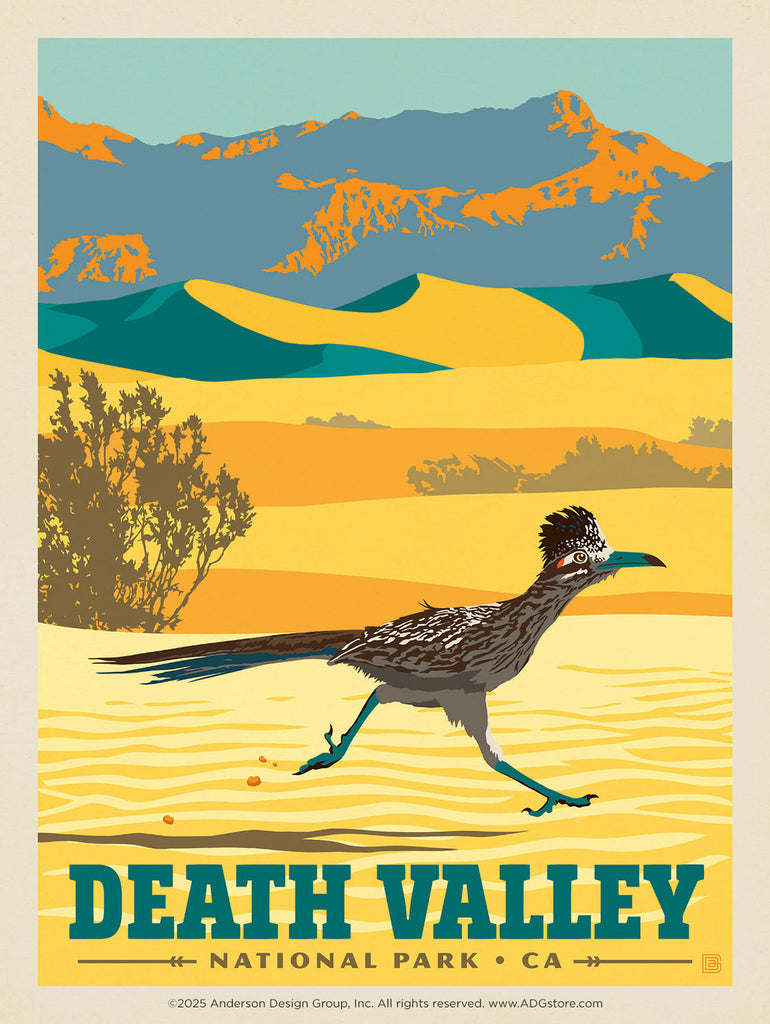
As artists and wilderness explorers, our passion is to venture into the 63 American National Parks, photograph and document the wonder of these natural places, and share our enthusiasm for the parks and other natural wonders by creating original, high-quality poster art for our 63 Illustrated National Parks Collection. In our travels, we’ve also developed an immense appreciation for national monuments, which inspired the American National Monuments and Natural Wonders collection.
The national parks, monuments, historic sites, memorials, recreation areas, forests, and other BLM land areas were, together, created to preserve America’s natural beauty and cultural history, with each protected site representing a significant chapter in the great American story.
Because we at Anderson Design Group believe strongly in preserving the parks and natural and historic spaces for future generations to enjoy, we’re always looking for opportunities to support the conservancies, foundations, natural history associations, and friend groups that protect these invaluable places.
To raise awareness for the important educational work, conservation, fundraising, youth involvement, and preservation activities taking place in some of the wilderness areas of California’s Eastern Sierra, we took some time this week to sit down with Wendy Schneider, Executive Director of Friends of the Inyo.
But first, enjoy the highlight reel below introducing Friends of the Inyo:
An Interview with Friends of the Inyo!
ADG: What is Friends of the Inyo? If you have an elevator pitch for what your group does, what would that be?
Wendy: Friends of the Inyo is a conservation organization focused on protecting and caring for the land and water of the area we now refer to as California’s Eastern Sierra. We work to protect the ecosystems and species of Inyo and Mono counties.
Wendy Schneider pictured below:

ADG: What are some of the programs your organization is involved in in those areas?
Wendy: We are working with national partners to prevent the sell off of public lands, to prevent the rescission of the Roadless Rule and other bedrock environmental laws. We are also working to restore budgets and critical staff to the land management agencies.
Just some of the beautiful and diverse landscapes within Friends of the Inyo's coverage area are pictured below:


We are fighting an industrial mining project in southern Inyo County that would negatively impact lands important to the Indigenous people of the region, and we are leading a campaign to reduce water extraction in the Owens Valley.
Also, this time of year, our Trail Ambassadors are out on the land, assisting the various agencies with trail work, leading interpretive events, and teaching Leave No Trace to visitors.
Recreation is an important activity, too, and we’re involved in that as well! Recreation is a critical economic driver for numerous communities in our service area, so we work with recreation interests by guiding where to build trails, where to avoid nesting birds, which Indigenous tribes to consult with on recreational development, etc.
Our group also has an educational component, where we bring schoolchildren into parks and forests and teach them about water conservation, safe and ethical resource extraction, biodiversity preservation, local ecosystems, and more.
In summary, our work encompasses a combination of advocacy, policy development, recreation support, education, and hands-on stewardship. For example, one project we’re currently involved in is the opposition to a potential gold mining exploration project in the Conglomerate Mesa area of the Inyo Mountains. To clarify, we are fighting this mining exploration project because it could lead to a mine that uses cyanide heap leaching to extract the Carlin type deposit gold from the soil. The project would be detrimental to these pristine desert lands because it would build miles of roads and create drilling platforms that would destroy vegetation and cultural sites, and severely disturb wildlife with its noise, light, and dust.
Advocacy is a big part of Friends of the Inyo's mission. See below:


ADG: How did Friends of the Inyo get its start? What’s the story behind the birth of your group?
Wendy: FOI began as a group of volunteers working to achieve several conservation objectives in the penultimate set of revisions to the Inyo National Forest Management Plan in 1986. Since then, FOI has become the Eastern Sierra’s go-to environmental group. We now engage on just about every matter that could impact our public lands and waters. We participate in the management plan processes, provide public input about proposed projects on our federal lands, and assist the land managers with stewardship on three national forests and two BLM field offices.
ADG: What types of projects does your group work on each year? What are some of the projects you’re most proud of? We’d love to hear about the work you’ve done in Death Valley National Park and Devil’s Postpile National Monument.


Wendy: In Devil’s Postpile, we ran a citizen science project in 2016 to gather data regarding plant life cycles. In Death Valley, from approximately 2018 to 2022, we worked with park personnel to mitigate damage from vehicle trespass. We worked together to develop a process involving spreading water and using giant squeegees to erase tire tracks and bring back the beautiful organic cracking of the playa.

ADG: Let’s talk about stewardship. Why is land stewardship important, and what does Friends of the Inyo’s stewardship look like?
Wendy: Our stewardship crews take care of trails, they brush back intruding vegetation, remove wandering rocks and logs, pick up trash, lead interpretive walks, and teach Leave No Trace practices to visitors. The federal land management agencies are overwhelmed, and, especially with recent cuts from the government, they have inadequate staff to mitigate all the damage done to our lands by the visiting public. Our stewardship program is crucial in helping to close the gap.
ADG: Given the extensive list of projects your group is working on, how do you enlist the help of the community in these projects? Do you organize volunteers? Or how do you otherwise fund your work?
Wendy: Our funding comes partially from private foundations and partially from member donations. And yes, we organize volunteers! For our stewardship work, we organize many volunteer events, some daylong events, some that last up to five days in the backcountry, all under the shared goal of getting our stewardship work done. We have new faces show up for this work every year, but we also have some of the same individuals returning year after year from all across the western U.S. as an annual tradition to help with these projects.
For our advocacy work, we organize public support or opposition to projects or legislative initiatives as necessary. We organize participation in public comment periods via letters, emails, and phone calls, and participation in public meetings. For example, we’ll send out a ping to several thousand advocates, who will spread the word, and we'll gather tens of thousands of public comments on a policy issue that we feel needs attention.
ADG: What goes on in the educational side of Friends of the Inyo? What are some of the educational programs your team is invested in?
Wendy: Our most visible educational program is SnowSchool. This is a program put together by a national nonprofit organization that we frequently partner with, Winter Wildlands Alliance.
The program presents several days of teaching in the classroom and then takes every 5th grader in the Eastern Sierra out for a day of learning about the snowpack and healthy watersheds. The day outside is really fun, we run in snowshoes, build snow creatures, and do the penguin slide (head first on your belly, of course).
Depicted below, snow adventures in Bodie Hills, one of the regions Friends of the Inyo recently secured as a protected nature area:


ADG: Looking to the future, what are the short-term and long-term goals for Friends of the Inyo? Where do you envision yourselves in five years? 10 years? What do you hope to be working on a decade from now?
Wendy: One short-term goal is to stop the destructive gold mining exploration project that is being pursued on Conglomerate Mesa. Another short-term goal is to prevent the selloff of our public lands and keep protections intact for our lands into perpetuity.
A decade from now, I hope we are working on finalizing the management plans for newly permanently protected areas in the Bodie Hills (northern Mono County) and on Conglomerate Mesa (southern Inyo County). I also hope that we are working with the Los Angeles Department of Water and Power on further reductions in water extraction.
ADG: Our artists have created a great deal of national and state park poster art. What are some of the places in your coverage area that you think deserve dedicated art pieces that we haven’t yet created art of?
Wendy: It would be great to see art created for Conglomerate Mesa and the Bodie Hills. Bodie Ghost Town is a state park (Bodie State Historic Park), so an illustration of that location would look great in your American Travel Collection or your National Monuments and Natural Wonders Collection.
ADG: One last question, if there were one thing about your group or about National Park/Forest/BLM land conservation/restoration/education generally that you’d want the broader public to know, what would that be?
Wendy: Our public lands in the United States are very special. It’s very special that they exist at all! They’re very worth protecting for many reasons, one of them being economic. Having healthy, well-funded, and well-protected public lands is crucial to the success of rural economies. It’s also important to our well-being as people. These places are priceless, and we should not even be considering selling them off. Doing so would be the biggest loss ever.
I would close with this statement: We need you to fight for your public lands now. Please stand up for laws that protect the health and well-being of our lands, because those same laws protect the health and well-being of our communities and our people.
Friends of the Inyo hosts a wildflower tour, see below:

ADG: We couldn’t agree more with those sentiments, Wendy! Thanks for sitting down with us today.
Wendy: Thanks for having me!
The Importance of Supporting National Park Foundations and Friends Groups
You can learn more about Friends of the Inyo at their website. If you want to support their work, you can donate.
If you represent a natural history association, foundation, friend group, conservancy, or preservation association that works in any of the 63 American National Parks or the hundreds of national monuments and other NPS sites across the U.S., contact us today to set up an interview! Just email ren@andersondesigngroup.com.
In the meantime, we’ll get back to creating vintage poster art and travel art of the national parks. Let’s enjoy these beautiful, historic places and do our part to preserve them for future generations.
-Ren Brabenec
Anderson Design Group Staff Writer
← Older Post Newer Post →